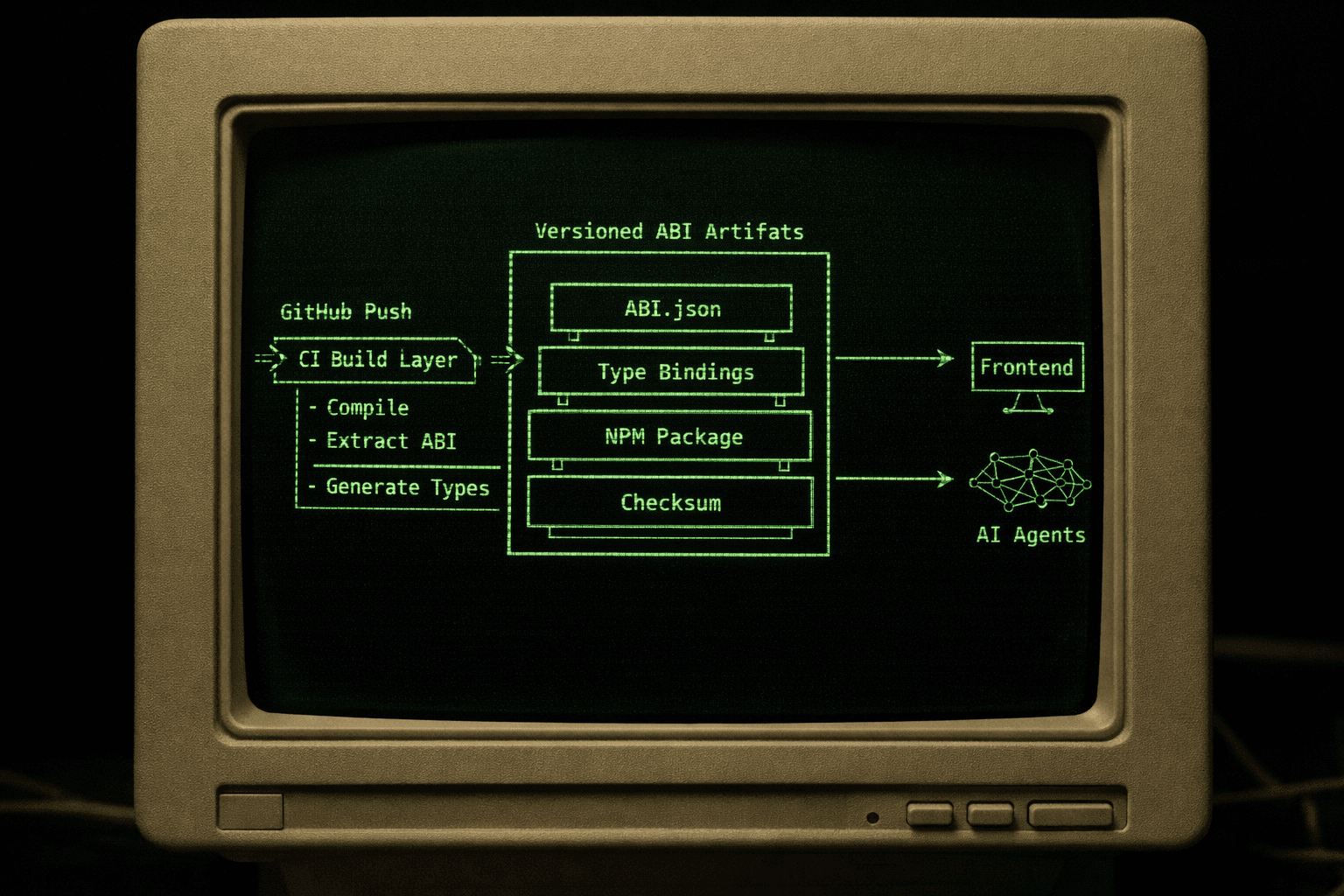
Smart contract tooling has matured a lot over time.
We have:
CI pipelines for tests
Deployment automation
Frontend CI/CD best practices
But there’s still one fragile integration boundary:
the contract interface layer: ABIs + type bindings.
Most teams still treat these as “generated files someone copies around”.
That’s where drift begins.
This post explains:
What ABI/interface drift looks like in the real world
Why it’s a coordination problem (not a discipline problem)
Why ABIs and bindings should be CI artifacts
How the interface layer can become infrastructure
Why this becomes even more critical when AI agents are in the loop
(You can explore GitMyABI at https://gitmyabi.com — this article focuses on the general problem & solution, not purely marketing.)
Update (August 2026): Since this piece was published, GitMyABI shipped exactly this kind of deterministic, agent-ready interface layer directly on Etherscan — see the “Installable Contract SDK” card on any verified contract page.
The Real Problem: Interface Drift
Frontend–contract bugs often look like logic errors.
But many are simply:
Frontend using an outdated ABI
Bindings generated from a different commit than deployment
Staging consuming prod interfaces (or the inverse)
Proxy upgrades where the interface change wasn’t surfaced
Wrong package version pulled by CI
“It works on my branch” mismatches
The key point:
The ABI (and bindings) are the integration contract. If they’re not versioned, hosted, and consumed deterministically, your boundary becomes fragile.
The Communication Problem Between Teams and AI Agents
In practice, this drift is rarely about the ability to generate an ABI.
It’s a coordination problem.
Typical scenario:
The issue is not that ABIs are hard to generate.
It’s that the source of truth is unclear.
The recurring questions:
Which interface is staging using right now?
Is it from the last deploy, or just last merge?
Which branch produced the bindings installed in CI?
Did the package publish happen, or did someone forget?
Is the UI using ABI v0.0.41 but the backend deployed v0.0.42?
👉 When the ABI is a file (“a folder in the repo”), responsibility is shared and ambiguous.
👉 When the ABI is an artifact, responsibility becomes structural.
What Changes When Interfaces Become CI Artifacts
Every push produces a versioned, addressable interface package.
Not just an abi.json.
But also:
Type bindings (e.g., TypeScript, and potentially Go/Java/Rust as your codegen expands)
Package versions tied to builds
Deterministic artifact URLs
Registry publishing (versioned, ideally immutable)
CI turns interfaces into publishable artifacts
The version bump is not manual. It is tied to the CI pipeline:
Push → Build → Extract ABI → Generate Bindings → Publish → Version increment
No developer needs to:
Copy files
Commit generated artifacts
Publish manually
Coordinate version numbers
The pipeline enforces consistency.
Deterministic Build Identity
Each successful build (manually triggered, or automatically triggered by a git push ) produces:
A build ID
A commit SHA association
A branch association
A package version (sequential)
A checksum/manifest
Stable artifact URLs
Example:
🚨 Those artifacts 👆 should be retrievable later exactly as published: no edits, no overwrites.)
Frontend no longer asks:
“Which ABI should I use?”
It references either:
a specific build, or
a branch snapshot (staging/main), or
the latest successful build for an environment
Explicit Environment Mapping
Instead of implicit coordination:
This mapping becomes explicit in configuration.
No manual copying.
No guessing.
No “did you update it?”
Immutable npm registry for Web3 interfaces
In Web3, ABI + type bindings packages are part of the trust surface, not just developer convenience. If interface packages can be changed or disappear, you lose the ability to prove what a dApp actually used.
An immutable registry enables:
Reproducibility: rebuild the same app later with the exact same interfaces.
Auditability: trace “this UI build consumed this interface version” without ambiguity.
Supply-chain resilience: prevent silent swaps of packages that shape approvals, transfers, and signatures.
That’s why the industry should treat interface packages as append-only, verifiable artifacts, ideally backed by immutable storage (e.g., NeoFS) while still supporting a fully npm-compatible install flow.
Once interfaces are produced and published deterministically, consumers stop syncing files and start pinning versions.
Putting it Together: Architecture Overview
Traditional Flow:
Automated Flow:
The integration boundary becomes explicit and versioned.
This isn’t only about tooling — it’s about coordination. When interfaces are published as versioned artifacts, teams stop syncing files manually and start consuming a single source of truth.
Why This Matters Even More for AI Agents
Humans are already bad at “which ABI is the right one?”
AI agents will be worse, unless the interface layer is machine-addressable.
If you want agents to build dApps reliably, they need:
the correct ABI for the target environment
the correct type bindings to avoid hallucinating signatures
a stable lookup mechanism (through MCP):
“give me the latest successful build for staging”
“give me interfaces for commit
ffaabbcc”“give me the package that matches deployment X”
So the next step is not just “ABIs as artifacts”, it’s:
interfaces as an AI-consumable contract catalog.
That unlocks workflows like:
an agent generates a frontend, installs
@org/contracts@0.0.42, and shipsan agent upgrades code when contracts change, guided by typed diffs
an agent picks the correct interfaces automatically for staging vs prod
In other words:
Developer Experience (DevEx) isn’t dead, but it’s evolving into Agent Experience (AgentEx). And the interface layer is where the leverage is.
This is where standards like MCP / ERC-8004 / x402 become relevant: discovery, identity, and payment rails.
Final Thoughts
Most teams eventually reinvent this:
sync scripts
CI guards
version bump automation
artifact publishing
“which ABI is staging using?” dashboards
What devs (humans) and AI Agents (robots) need is a standardized and dedicated interface CI/CD layer with:
deterministic builds
canonical artifacts
npm bindings as first-class outputs
private/public publishing
explicit environment mapping
a foundation for AI/agent-ready consumption (MCP + ERC-8004 + x402)
The interface layer becomes infrastructure, not a folder someone remembers to update.
If you’re curious and want to give it a try, you can generate a typed client straight from any verified contract on Etherscan (look for the Installable Contract SDK card), or sign up directly at:
Author: Guil. Sperb Machado, Ph.D.
CEO & Builder @ AxLabs