Smart Contracts
GitMyABI
Infrastructure for Smart Contract Interfaces
Client
AxLabs (Self-funded)
Year
2026
Category
DevTooling & DevEx
Duration
6 Months
Technology Stack
Overview
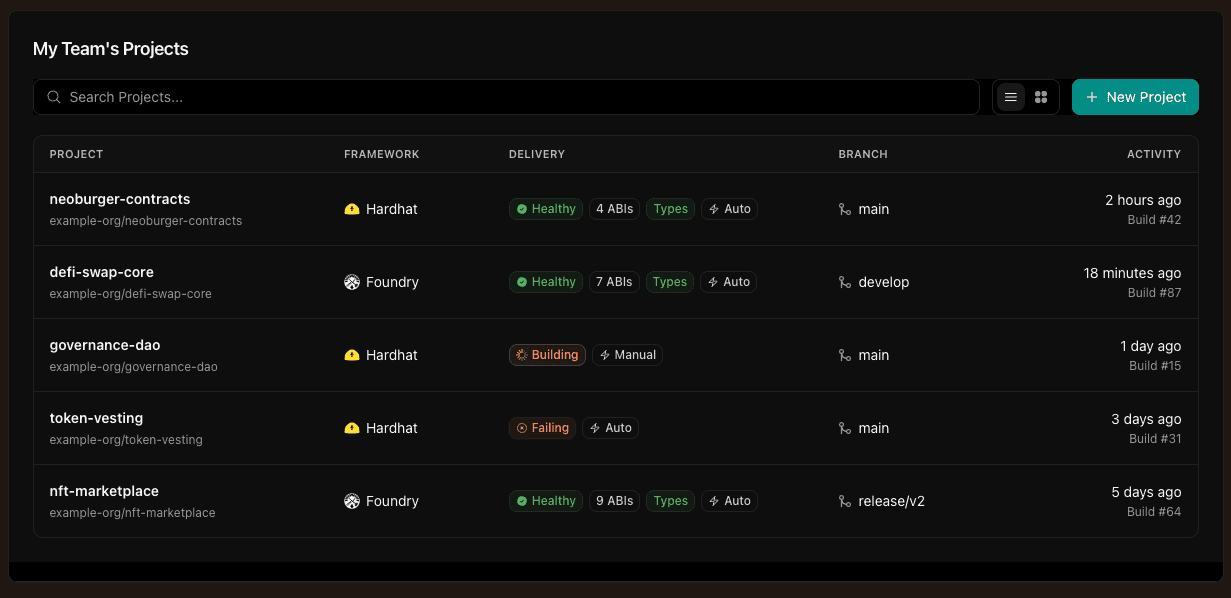
GitMyABI is a CI/CD layer for smart contract interfaces. It automates ABI generation, versioning, hosting, and type binding delivery, turning one of Web3’s most fragile integration points into reliable infrastructure.
As decentralized applications scale, teams struggle with ABI drift between smart contracts and frontend environments. GitMyABI eliminates coordination overhead by making interfaces first-class build artifacts that are easy to consume by both humans and AI agents.
Check our in depth editorial about Treating ABIs + Type Bindings as First-Class CI/CD Artifacts
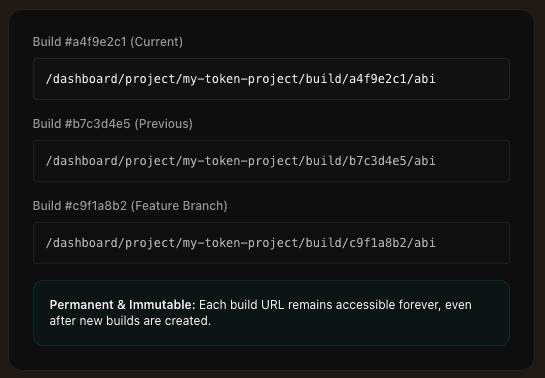
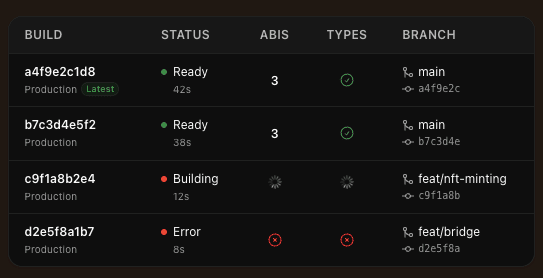
Each build produces:
Deterministic ABI
Sequential build version
Integrity checksum
Public or private npm package
Stable, addressable URL per build
Branch-aware artifacts allow frontend environments to map directly to corresponding contract branches, eliminating staging/prod mismatches.
Shipping on Etherscan
GitMyABI now powers the "Installable Contract SDK" card on Etherscan's verified-contract pages. Any developer looking at a verified contract on Etherscan can one-click generate a typed, viem-based client — complete with TypeScript bindings — and install it straight from npm, without leaving Etherscan.
This closes the loop between contract discovery and verification (Etherscan) and production-ready integration (GitMyABI): the two tools we see as complementary halves of the same workflow.
Impact
With GitMyABI, teams spend less time chasing interface mismatches and more time shipping:
Fewer broken builds: ABI drift gets eliminated as a recurring failure mode
Faster frontend iteration: developers install the right package instead of hunting for the right ABI
Cleaner staging vs production: branch-aware artifacts reduce environment mismatches
Less coordination overhead: fewer “did you update the ABI?” loops across teams
Lower debugging cost: traceability to commits makes failures faster to pinpoint
Agent-ready interfaces: AI tooling can fetch the correct interfaces deterministically, saving tokens and retries
Conclusion
Smart contract interfaces shouldn’t rely on manual coordination or implicit versioning. As Web3 applications scale, the interface layer must evolve from a generated file into reliable infrastructure: consistent, traceable, and versioned.
This becomes even more important as AI agents and LLMs in IDEs start interacting with smart contracts directly. It’s not only human developers who need correct interfaces, agents do too! They need agility: deterministic lookups, correct types, and workflows that save LLM tokens so more work gets done faster, with fewer failed attempts and less back-and-forth, just like good tooling does for humans.